
Interstellar Gymnastics
What Age Should My Child Start Gymnastics? A Coach's Honest Answer
Starting ages, what toddler classes really build, and why it is never too late to begin.
By the coaching team at Interstellar Gymnastics, Santa Clara, CA. Published August 31, 2026.
TL;DR
Kids can start gymnastics around age one, but those early years are about body awareness, not skills. Real training begins around five or six. And there is no upper limit. At Interstellar Gymnastics in Santa Clara we have coached everyone from nine-month-olds rolling in the foam pit to adults past 60 learning their first backflip.
Every week a parent asks us some version of the same question. Is my kid old enough for gymnastics? Did we already miss the window? The honest answer is more interesting than a single number, because the right starting age depends on what you want gymnastics to do for your child. Here is how we think about it inside the gym, after decades of coaching and judging at every level of the sport.
Page navigation
The youngest we have ever started: nine months
The youngest child our head coach has worked with was nine months old. There was no gymnastics happening. He was falling onto mats, rolling around the foam pit, and getting familiar with his own body. That is the whole point at that age.
That might sound like it is not worth much. It is worth more than most parents expect. Body awareness, comfort with falling, and time spent hanging and climbing become the raw material every later skill is built from.

Age 1 to 3: familiarity, not training
Around age one, a child can join a Parent Tot class and genuinely benefit. Here is what actually happens in ours, because parents sometimes assume it is just playtime.
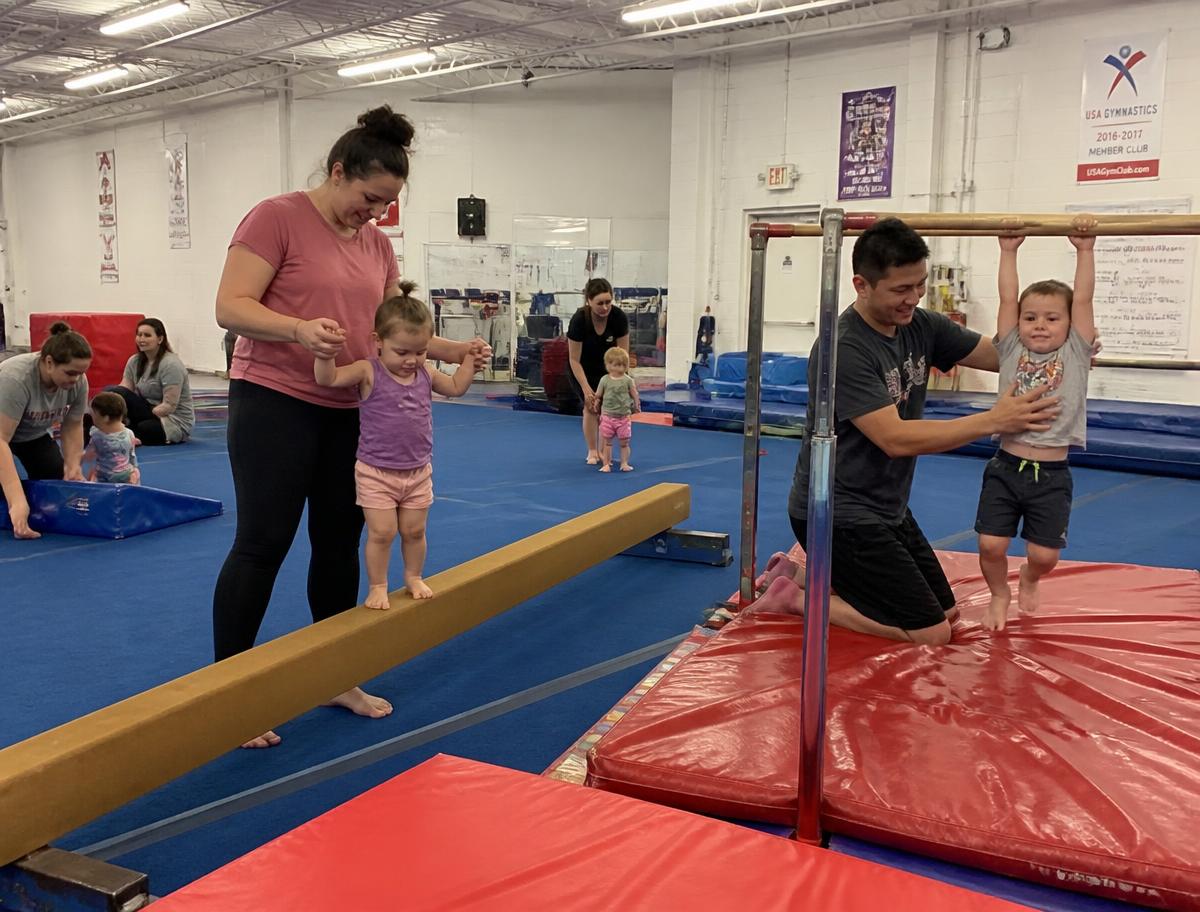
A Parent Tot class runs through real rotations: a floor rotation, a trampoline rotation, a tumble track rotation, a bar rotation. Kids hang from bars, walk across beams holding a parent's hand, jump into the pit, crawl through the pit, and learn basic movements like log rolls. No real gymnastics is done, and that is by design. It is body awareness, foundational strength from all that hanging and climbing, and a small person learning that this big padded room is a place where trying things is safe.
If you want the ideal path, this is it: in the gym around age one, building familiarity and foundational strength for a few years before anything that looks like training begins.
Age 5 to 6: where real training starts
Actual training, with skills, progressions, and structure, starts around five or six. This is the age where kids can follow multi-step coaching, hold positions, and start stacking skills on top of that early foundation.
How fast does it go from there? It depends on the kid, and mostly on one thing parents rarely think about: willingness to be upside down. Some kids find being in the air completely natural. For others it is genuinely terrifying, because most children have almost no experience being airborne or inverted before gymnastics. That fear, not age, is usually the real variable in how fast skills come.
For a kid who is willing to try, there is no reason a cartwheel cannot come in a week, and a decent back handspring on the tumble track within a couple of months. The limiter is rarely the calendar. It is strength, flexibility, and the courage to go upside down, and all three are trainable.
What we look for in a ready kid (it is not talent)
When a parent brings in a three or four year old, we are not scanning for a future Olympian. We are looking for coachability. Is the kid willing to try new things? Willing to put themselves out there? Do they listen to feedback and apply it on the next turn?
Honesty matters here: gymnastics hurts a little. Flexibility work is uncomfortable. Hands sometimes rip on the bars. The kids who thrive are not the most talented ones. They are the ones who try the hardest, listen, and come back to the next turn with the correction applied.
The biggest mistake parents make
It is not starting too late. It is pushing a kid who does not want to be there.
Sometimes the gymnastics dream belongs to the parent, and the child only shows up because the parent wants them to. Beyond making the sport miserable, there is a safety issue coaches see clearly: a checked-out kid in a gym full of moving bodies and equipment gets hurt, or hurts someone else, very quickly. A kid who is having fun pays attention. Attention is safety. If your child is not enjoying it, that is worth solving before anything else.
Started late? Here is the truth about catching up
Plenty of kids walk into our gym for the first time at 14 or 15. Most of them want one thing: to tumble. They are usually less interested in the strength work and competition side, and that is completely fine. Tumbling classes exist for exactly this.
Can a late starter go far? Gymnastics is demanding. There are six events for boys, flexibility is practically its own event, and the strength requirements are real. Earlier is easier. But it is never too late, and we mean that literally: we have taught people past 60 to do their first backflip in our adult gymnastics classes. What matters is the effort and work you are willing to put in.
Boys vs girls: any difference?
Not really, in terms of the path. In our experience girls tend to develop a little faster early on. Flexibility and some skills come easier, so they often learn quicker at the start. The programs, the milestones, and the long-term trajectory are the same.
What the long game looks like
The payoff of starting young and staying with it is not a trophy at eight years old. It is what the process builds over a decade. Kids who came up through our full program, through the levels and preteam and competitive team, have graduated and gone on to colleges all over the United States.
That is the frame we would offer any parent stuck on the age question. Big dreams start here, and they are built through the process: year over year of showing up, trying the scary thing, and getting a little stronger than last month. The starting age matters far less than the staying.

The short version
Around age 1
Start Parent Tot for body awareness and foundational strength
Ages 3 to 4
Independent preschool classes, still foundation over skills
Ages 5 to 6
Real training begins
Ages 6 to 12
Skill years; cartwheels can come in a week for a willing kid
Teens
Never too late, tumbling is a great entry point
Adults
Yes, really; our oldest first backflip belongs to someone past 60
Wondering where your child fits? Every new student at Interstellar gets a free trial class, any age, any level. Come see which class feels right.
Starting age questions parents ask us
Straight answers from the coaching floor in Santa Clara.
Ready to reach for the stars?
Enroll today and give your child a place to grow stronger, braver, and more confident.